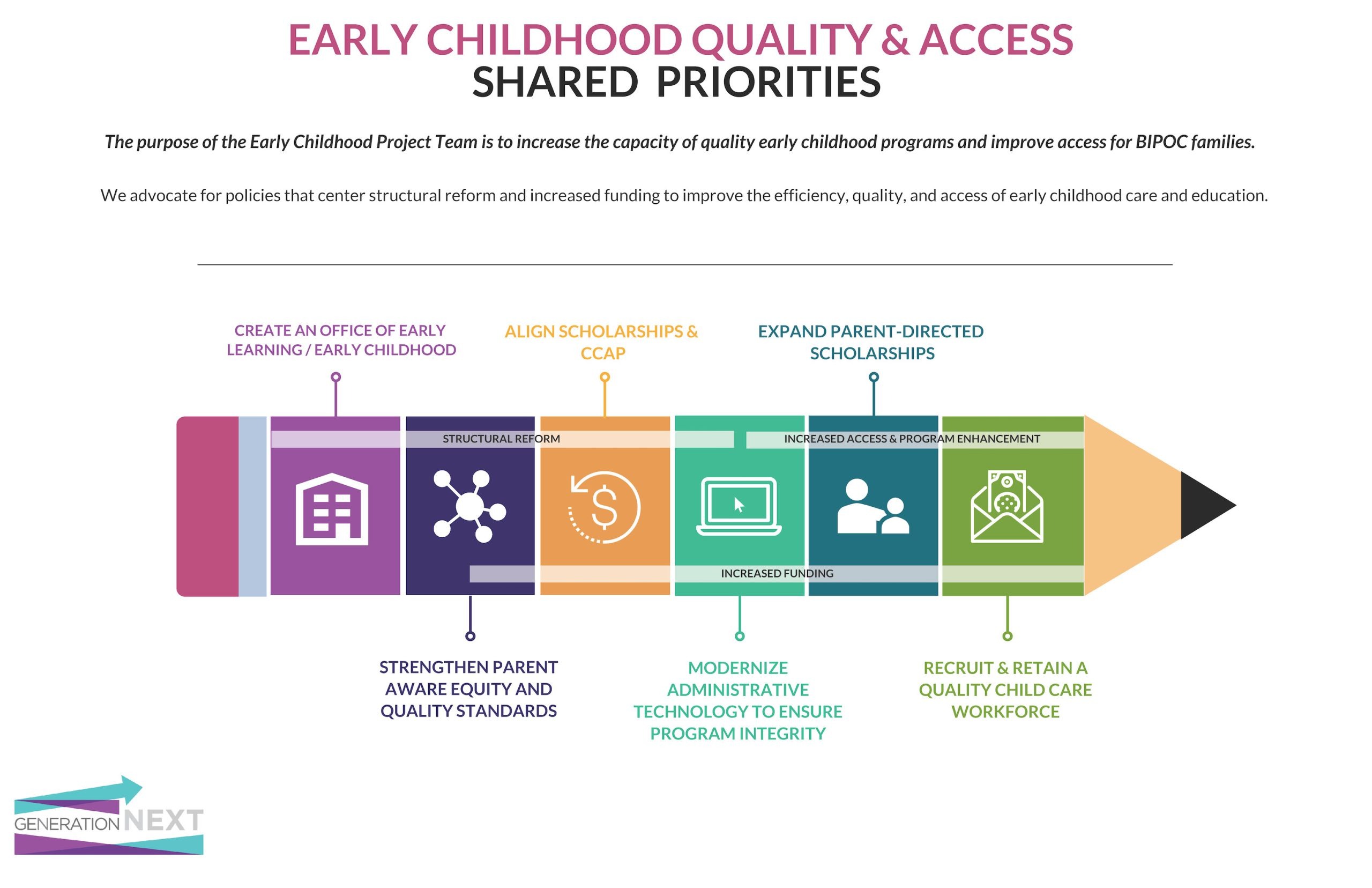
Early Childhood Quality & Access
OBJECTIVE: To increase the capacity of quality early childhood programs and improve access for BIPOC families.
Generation Next prioritizes equitable access to high-quality early childhood education (ECE) for all families in the Twin Cities. By addressing systemic barriers, we work to ensure that children—regardless of income, race, or zip code—receive the early learning opportunities they need to thrive.
How Families Navigate a Fragmented Early Childhood System
Throughout 2025, Generation Next worked to better understand what families experience when navigating early learning systems, particularly amid federal funding delays and cuts. Together, we delved into the complexity of scholarship pathways, the Child Care Assistance Program (CCAP) and Head Start requirements, and the capacity constraints on families in navigating Minnesota’s mixed delivery early childhood system. Building on lessons from past policy efforts, the Project Team looked closely at how early childhood programs —such as CCAP, Early Learning Scholarships, and federal and state funding—interact across a mix of funding sources and requirements. We highlighted both the opportunities and challenges of coordinating funding across programs, and what clearer alignment could mean for creating a more effective and sustainable system for children, families, and providers.
When Minnesota transitioned to the Department of Children, Youth, and Families (DCYF) in July 2024, it brought new opportunities to better align funding, scholarship programs, and early learning guidance. Generation Next is focused on what clearer coordination could look like in practice, and what it would take for families to experience those changes in their lives.
What the Data Show About Quality, Affordability & Access
Generation Next also examined how the language used to describe “quality” and “access” is understood by families, noting that definitions across organizations and communities are not always aligned or clear. At our 2025 Annual Event, which brought together over 90 education leaders, we shared how system fragmentation shapes day to-day decisions for families in Minneapolis and Saint Paul. To address systemic gaps, we worked with partners in our coalition to explain affordability and access challenges in clear, accessible language.
Building on our 2024 local impact study of the Great Start proposal, Generation Next spotlighted findings in “Increasing Access to High-Quality Early Care & Education,” which showed the impact on families in local neighborhoods and communities around the state, who often pay well above the 7% affordability benchmark for child care, with infant care on average costing more than tuition at the University of Minnesota.