by: Jeremiah Ellis, Director of Outreach & Partnerships, Generation Next
There is something truly transformative about stepping into a room full of people who refuse to accept the status quo for our children and youth. From June 10–12, our Minnesota coalition team joined fellow Cradle to Career Network members, state policy leaders, and national partners in Washington, D.C., for the 2026 StriveTogether Policy Summit.
Representing our state on the ground, our Minnesota delegation brought together a powerful mix of state agencies, statewide coalitions, and place-based partners. Our team included Alyson Gagner (Expanded Learning Opportunities Specialist, Minnesota Department of Education), Josiah S. Litant (Executive Director, Minnesota P-20 Education Partnership), John Fanning (Director, Minnesota Education Partnerships Coalition), Jeimmy Yusty Rojas (Director of Cradle to Career Initiatives, Goodhue County RiseUp Partnership), Julie Ruzek (Executive Director, Rochester Cradle 2 Career Initiative), and Sondra Samuels (President & CEO, Northside Achievement Zone), Generation Next Leadership Council member, alongside myself.
This wasn’t a standard sit-and-listen conference. It was a hands-on, action-oriented working summit designed to take our local momentum across Minnesota and bridge it directly to state policy and federal advocacy. Every session, working group, and Hill visit was anchored in a shared, urgent goal: advancing systems change and public investment so that 4 million more children across the country reach economic mobility by 2030.
Building State Policy Coalitions: Moving from Local Impact to Statewide Systems
A central theme throughout the summit was understanding the state as the critical unit of change. Local, place-based work in our Twin Cities communities remains our foundation, but achieving durable equity requires connecting neighborhood-level civic infrastructure to robust state-level policy and funding.
During the State Policy Coalition Working Sessions, we rolled up our sleeves alongside peers from across the country to align our strategies around the full cradle-to-career continuum—from early childhood and K–12 to post-secondary completion and career pathways.
A major focus of these sessions was diving into strategic budget analysis, specifically exploring the “1% Target.” By analyzing cumulative state budgets across early childhood, K–12, higher education, workforce, and human services, state coalitions are mapping out how to connect, repurpose, or redirect public funds toward proven, place-based strategies.
We also spent critical time focusing on the power of Statewide Longitudinal Data Systems (SLDS)—or SLEDS, as we know it in Minnesota. As we highlighted throughout the summit:
- Integrated data isn’t just an administrative compliance exercise; it’s an essential tool for identifying systemic pain points and scaling community bright spots.
- When tracking outcomes from early childhood through higher education and early-career mobility, actionable data allows local coalitions to prove return on investment and advocate for systemic shifts.

Advocating on Capitol Hill: Elevating Minnesota’s Vision with Congressional Offices
On Day 2, we took our unified message to Capitol Hill.
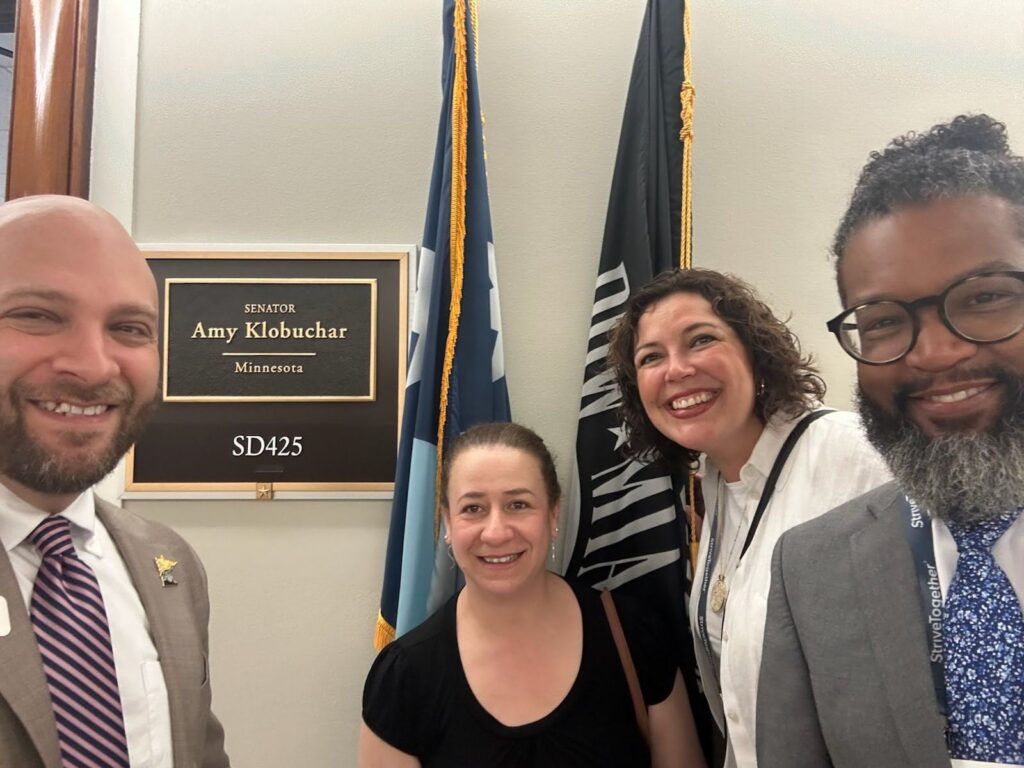
Our Minnesota Education Partnerships Coalition (EPC) delegation met directly with congressional staffers for Senator Amy Klobuchar, Representative Pete Stauber, Representative Angie Craig, and Representative Brad Finstad offices, to discuss the opportunities and challenges facing our state’s youth and families. We were joined by our colleague from the Minnesota P-20 Education Partnership, who provided context on the state’s cross-sector education and workforce strategies and priorities.
During our conversation with congressional offices, we anchored our discussions in several critical priorities:
- Protecting and Investing in Data Infrastructure: We highlighted Minnesota’s leadership in utilizing SLEDS to track student trajectories and outcomes, emphasizing why federal support for integrated data systems is vital for community-based organizations driving equity.
- Whole-Child & Continuum-Wide Success: We shared updates from our partners across the state—from Rochester Cradle to Career’s focus on prenatal-to-age-3 disparities and post-secondary FAFSA/North Star pathways, to the RiseUp Partnership in Goodhue County working across sectors to strengthen cradle-to-career outcomes, including engaging youth in decision-making and supporting the Goodhue County Education District Reading Center’s efforts to ensure all students have access to high-quality reading instruction.
- Addressing Structural Barriers: We elevated the urgent child care crisis affecting workforce development across all 87 Minnesota counties, alongside the importance of expanding non-traditional career pathways like trade programs and apprenticeships.
- Navigating Federal Grant Stability: We expressed shared concerns surrounding federal budget dynamics, potential shifts in federal grant disbursement processes, and the critical need for stable, predictable funding streams for essential programs like Head Start and 21st Century Community Learning Centers.
It was an encouraging and grounded discussion. While the federal landscape naturally carries uncertainties, having the opportunity to bring authentic, place-based community insights directly to our federal leaders ensures Minnesota’s children remain at the center of the legislative conversation.
What’s Next: Turning Momentum into Action
We returned to Minnesota equipped with clearer priorities, emerging budget frameworks, and renewed energy. Over the coming months, Generation Next will continue working hand-in-hand with our statewide coalition partners, local leaders, and community members to translate the Policy Summit lessons into concrete action here at home.
To everyone doing the daily work across Minneapolis, St. Paul, and our broader Minnesota network—thank you. Together, we are building a continuous pipeline of support where every young person can thrive, from cradle to career.