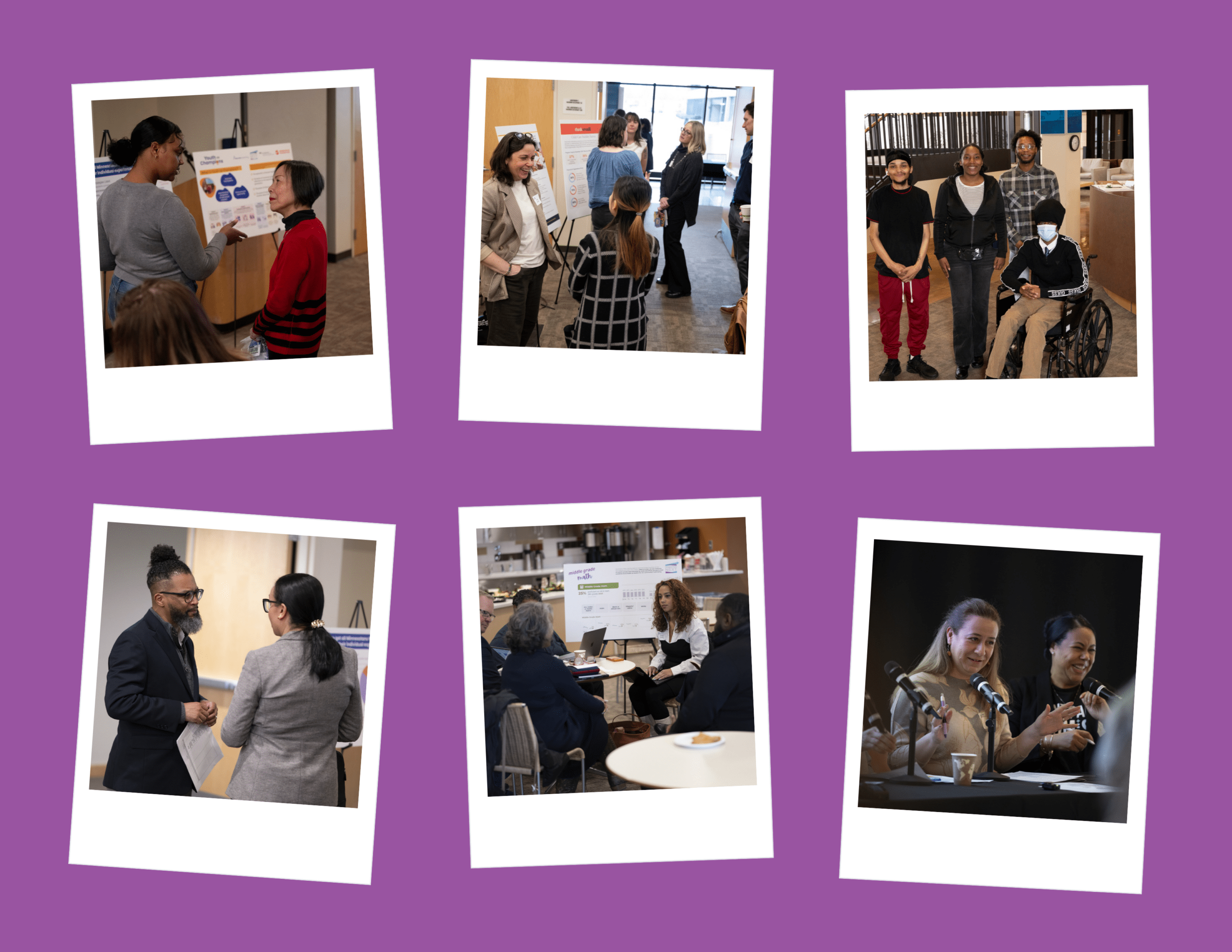
 A big collective thank-you to the 132 people, representing over 70 organizations, who came together with Generation Next on March 26 to explore “Pathways to Possibility” at the Wilder Center in Saint Paul.
As Dr. Lisa Sayles-Adams shared, “our most important assets are our children,” grounding the day in our shared sense of responsibility across sectors and geography.
We’re also deeply grateful to our table discussion leaders and data docents who helped bring the data walk and breakout conversations to life, as well as our panelists who shared how they are building collective engagement in their communities—both across Minnesota and nationally. Thank you to Armando Camacho, President & CEO of Wilder, and Karen Kelley-Ariwoola, Chief Operating Officer at Northside Achievement Zone (NAZ), for their opening and closing remarks. Thank you to all our partners at Saint Paul Promise for sharing space with us!
Throughout the day, we heard the importance of connection—how our priority areas and goal areas intersect and build on one another across the learning journey, and how essential it is to stay strong as a united coalition, especially amid the ongoing uncertainty impacting our communities. Across speakers, the Data Walk, and small group conversations, a clear throughline emerged: meaningful change will require deeper alignment, shared ownership, and systems that reflect the real experiences of young people and families.
No single district, organization, or system can do this alone
 Wilder Foundation President & CEO Armando Camacho provided opening remarks for the day.
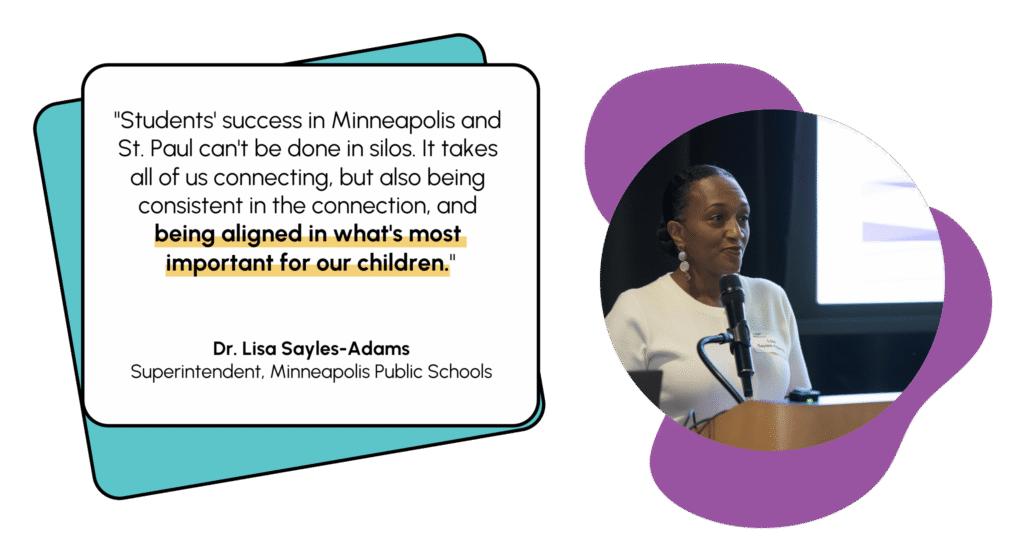
For our community to meet this moment, Minneapolis Public Schools Superintendent and Generation Next Leadership Council Co-Chair Dr. Lisa Sayles-Adams emphasized the importance of alignment and collective action. “Students’ success in Minneapolis and St. Paul can’t be done in silos,” said Dr. Sayles-Adams. “It takes all of us connecting, but also being consistent in the connection, and being aligned in what’s most important for our children.”
This idea showed up not just in speaker remarks, but in how the event was intentionally designed by Generation Next and our partners. As Joe Munnich shared, the goal of gathering and working together is to “see what we can do together that we can’t do alone,” reinforcing that this work depends on coordinated, cross-sector action.
“It takes a village, and each one of us is part of that village.” – Dr. Lisa Sayles-Adams
The event itself—bringing together Minneapolis and St. Paul public schools, nonprofits, city leadership, regional networks, funders, and more—was a living demonstration of that message. “My pathways to possibilities began right here in Saint Paul,” reflected Armando. “I was six years old when my grandparents brought me to the West Side from Puerto Rico…Today I can stand here with all of you, not because I did it alone, but because people and systems showed up for me. That’s what this is about. Not just programs, not just strategy. Systems that were consistently there for every young person.”
 Data as shared language — accountability, equity, and community voice
Referencing attendance rates, graduation figures, literacy benchmarks, Asset Limited, Income Constrained, Employed (ALICE) affordability metrics, and the statewide SLEDS longitudinal data system, Annual Event attendees shared and discussed a range of data affecting our students, families, and communities. During our Data Walk–a centerpiece of every Annual Event–participants had a chance not just to walk the data but talk the data.
VIEW OUR 2026 ANNUAL EVENT DATA BOARDS ON OUR PUBLICATIONS PAGE
As Generation Next Executive Director Joe Munnich said, “Data is not the end of the story. It is the beginning of telling our story together…Please use the data walk as a time for conversation and pushing each other to see how we’re going to show up and change results.”
Participants took that invitation seriously by not just observing the data at the data walk, but analyzing it. In small groups focused on our goal and priority areas, conversations moved quickly from “what does the data say?” to answering:
- What barriers/challenges do you see in this area?
- What opportunities do you see?
- What are your hopes and dreams for young people at this stage of the Learning Journey?
- What do we want to bring back to the group to support?
Across small group discussions, several challenges and areas for growth emerged:
- A need for more accessible and coordinated systems, especially in the early childhood space, where families face barriers related to affordability, transportation, and navigating multiple systems at once.
- Ongoing concerns about data privacy, ownership, and who gets to interpret and share data and the story behind the data–particularly when community voices are not always at the table.
- A recognition that current data systems don’t always reflect the full range of student experiences, especially for students who don’t follow traditional postsecondary pathways.
At the same time, there was strong alignment around opportunities: using data not just to measure outcomes, but to better understand the drivers behind them–and to inform more responsive and community-driven solutions.
This theme ran throughout the conveying, from the words of our “State of Our Scholars” speakers to the “Our Shared Impact” panel to the breakout sessions concluding our afternoon together. “Communities who are making and achieving long-term impact have committed to a shared community vision that centers family and youth,” shared StriveTogether’s MaKenzie Mosby during the panel alongside Tiffany Scott Knox (Saint Paul Promise), Michelle Palo (Northside Achievement Zone), Michelle Baker (Austin Aspires), and Jeimmy Yustas-Rojas (Rise Up Partnership)–all Generation Next’s fellow members of the Minnesota Education Partnerships Coalition (EPC) and national network StriveTogether.
The idea of data as a living, interactive thing was echoed by Wilder Research Executive Director Dr. Heather Britt, a member of the Generation Next Executive Committee, during our breakout session share-out. “What does it mean to have young people involved in the interpretation, the understanding, the storytelling, the writing of the narrative around what this data says…How they want to communicate it, how they want to share it, what we want to do about it?”
These questions were especially timely as the Annual Event marked the launch of our new Youth Data Crew, members of which were in attendance. In partnership with Youthprise, this 4-month fellowship for Twin Cities youth ages 16-24 will help them build data literacy skills, learn how education data is used to make decisions, and guide the growth of our community co-created Education Equity Data Hub.
Whole-child education: social emotional learning, belonging, and student voice
Whether discussing the traumatic efforts of Operation Metro Surge on our students and families, addressing the need for student voice in data-driven efforts, or lifting up the need for a stable home environment and food security to strengthen learning, Annual Event attendees all spoke to the importance of whole-child (and whole-family) support in helping students thrive.
Small group conversations reinforced that academic outcomes cannot be separated from broader conditions. Participants pointed to the importance of:
- Mental health supports, particularly for young and neurodivergent students
- Creating spaces where young people feel heard, connected, and able to experience joy, not just academic achievement.
- Helping families define what postsecondary success means for them, rather than relying on one-size-fits-all pathways.
There was also a clear call to engage youth and families earlier and more meaningfully, including the impact of giving students the chance to see how the world outside their classrooms affects their learning and lives. In our Shared Impact panel, Michelle Baker of Austin Aspires shared the experience of bringing students to the Minnesota State Capitol for the Education Partnership Coalition’s Day on the Hill. “It was not just a day out of school up at the Capitol for them,” Michelle reflected. “It was an opportunity for them to see that setting, to see what the roles are and what things are happening [at] the Capitol. It might not have been something on their radar as a possible future, but after seeing it firsthand, they could see themselves there now.”
Community rising: resilience, advocacy, and the power of showing up together
The Annual Event itself—its huge turnout, cross-sector presence, and attendees’ openness to building relationships with new connections and old—reflected the solidarity and resilience our school communities have shown the world these past several months.
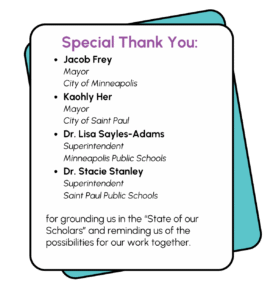
As Mayor Jacob Frey said in his opening, “I know that so many of you have been very much on the frontlines. There’s no doubt in my mind that it is your work collectively that helps keep our society and education system together.”
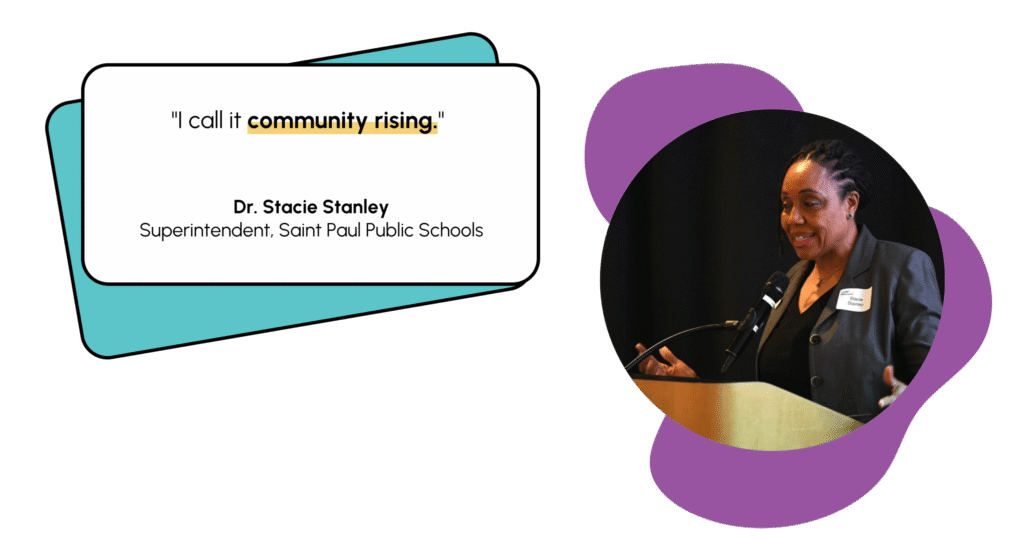 “I call it community rising,” said St. Paul Public Schools Superintendent and Generation Next Executive Committee member Dr. Stacie Stanley. We learned a different definition for neighbor in Saint Paul Public Schools. We had, and still have, community members who have stood two blocks deep, north, south, east, and west to protect our students and families.”
When students and families were afraid to leave their homes, in 72 hours Saint Paul Public Schools had a remote learning system up and running that was serving 3,500 students within 90 minutes of launching—and eventually served nearly 8,000 students. “We really wanted to make certain that our students did not have to detach from their beloved teachers, because we know it’s traumatic enough to have to leave your community.”
Similar efforts happened in Minneapolis, where Superintendent Dr. Lisa Sayles-Adams spoke of the resilience schools, parents, and community members showed in establishing each campus as a safe space and a “fortress.” She also went on to capture what our coalition can do, together, going forward. “It’s the people in this room that will put things back together and help our children navigate so they can thrive.”
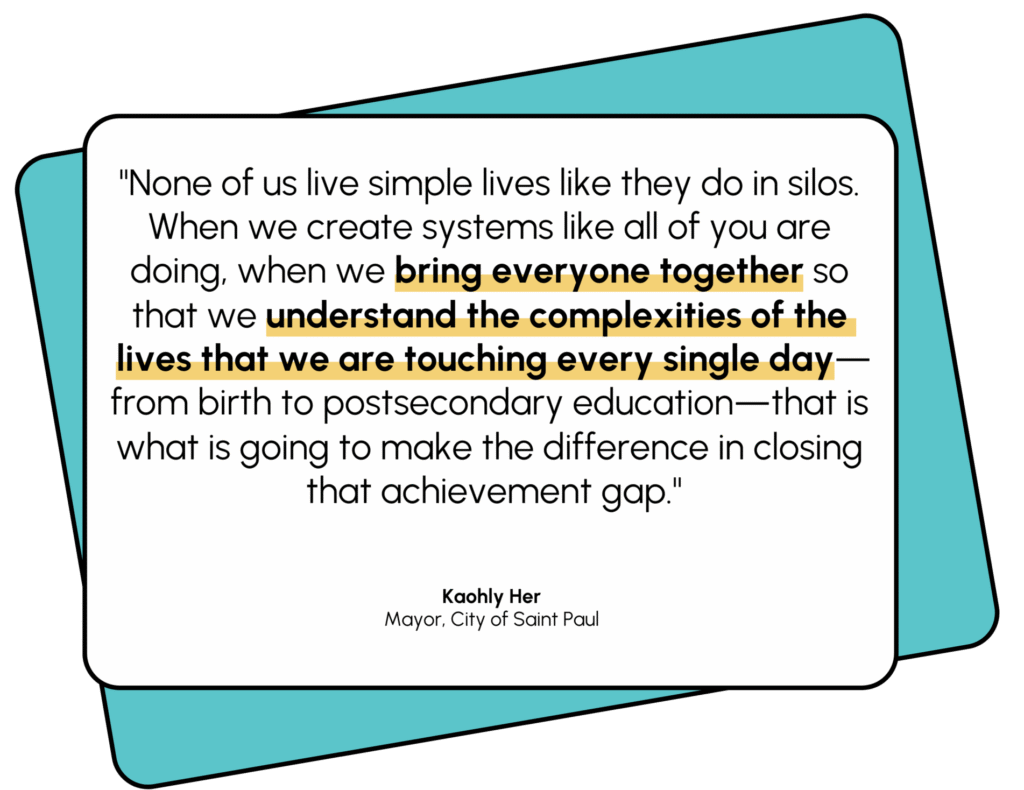
As the event drew to a close, Saint Paul Mayor Kaohly Her echoed those sentiments and captured the power of collective action as we all work to build pathways to possibility.